
A new report from the Stockholm International Peace Research Institute (SIPRI) indicates that India has expanded its nuclear arsenal and is developing long-range weapons capable of reaching targets across China, while also maintaining focus on its rivalry with Pakistan.

Pakistan has criticised India's recent remarks on Pakistan-occupied Kashmir (PoK) protests, asserting it is addressing issues democratically. Pakistan also warned India against blocking water, calling it an "act of war," and commented on India's nuclear capabilities and its own military strikes in Afghanistan.

India is increasingly focusing on long-range weapons capable of reaching targets across China.

The United States, Russia, United Kingdom, France, China, India, Pakistan, Israel and North Korea possess approximately 16,300 nuclear weapons collectively. A glimpse of nine countries with nuclear weapons.

China has confirmed providing on-site technical support to Pakistan during last year's conflict with India, according to official media reports.
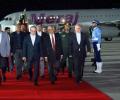
A new report alleges Pakistan shielded Iranian military aircraft from potential US airstrikes, raising questions about its role as a neutral mediator in the ongoing US-Iran tensions.

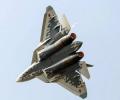
Russian President Vladimir Putin has offered New Delhi Russia's fifth-generation stealth aircraft Sukhoi Su-57 and even suggested that the combat jet could even be jointly produced in India in line with the strong strategic partnership between the two countries.

Defence Minister Rajnath Singh emphasizes the need for India to remain prepared for uncertainty, even during peacetime, and highlights the increasing importance of the defence sector as an economic driver.

India's defence expenditure surged to $92.1 billion in 2025, making it the world's fifth-largest military spender, according to SIPRI data. This 8.9 per cent year-on-year rise was primarily driven by operational and procurement needs following heightened regional tensions with Pakistan in May 2025.
While China's arms imports accounted for nine per cent of the global defence sales, the same figure for India was seven per cent
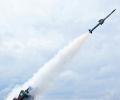
'There are only a few countries in the world that have deployed combat-ready laser systems.'
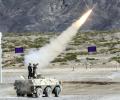
The Chinese military Thursday declined to comment on the performance of China-made weapons used by Pakistan in the recent conflict with India.
India's import of weapon systems is three times higher than Pakistan and China as it continues to be the largest buyer of arms in the world, a Swedish think tank said on Monday.
India and Pakistan are continuing to work towards developing new systems for delivering nuclear weapons and are expanding their capacities to produce fissile material for military purposes, according to an international think tank report.
India has emerged as the world's largest arms importer, overtaking China which shared the second spot with South Korea followed by Pakistan, according to a report by Swedish think-tank, the Stockholm International Peace Research Institute.

Refuting reports about an increase in its nuclear arsenal, China on Monday said it has kept its capability at the "lowest level", commensurate with the need for national security. "We always kept our nuclear capability at the lowest level, commensurate with the need for national security," Chinese foreign ministry spokesman Hong Lei told a media briefing.
However, these are understood to be exploratory talks, with an agreement unlikely to be formalised during the current visit.
India has added roughly 10 nuclear warheads for a total of 90 to 110 in 2012; Pakistan has increased its warheads by about 10 to between 100 and 120; and China now has 250 against 240 in 2012, the Stockholm International Peace Research Institute (SIPRI) said in its annual report.
China has denied reports that Southeast Asian nations are building up their militaries and edging closer strategically to the United States as a hedge against the Communist nation's rise.The latest data released by the Stockholm International Peace Research Institute shows that weapon purchases in the Southeast Asian region almost doubled between 2005 and 2009.
We present some the 'coolest' futuristic weapons that are being developed right now, according to a Business Insider report:
Hard-selling American military technology to India, United States President Barack Obama has assured Prime Minister Manmohan Singh in a top-secret letter signed by him that the 'US is a willing, capable and reliable defence partner to India'.
"As per a report published in March 2012 by the Stockholm International Peace Research Institute (SIPRI), India has become the largest importer of arms during 2007-11 and accounted for 10 per cent of global arms import as compared to to Chinese share of five per cent", Defence Minister A K told the House in a written reply.
India spent Rs 15,443.01 crore during 2010-11 to import arms and ammunition marking an increase of Rs 5,266.93 crore as against the defence expenditure in 2007-08, the government said on Monday.

1464 billion dollars -- That's what nations around the world spent to secure themselves from their adversaries' misadventures.

Nearly all of the nine nuclear-armed States, including India and Pakistan, continued intensive nuclear modernisation programmes in 2024, upgrading existing weapons and adding newer versions, according to a report by a global think-tank.
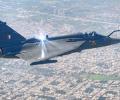
India's military expenditure in 2024 was nearly nine times that of Pakistan's, according to a study released by the Stockholm International Peace Research Institute (SIPRI). India's spending reached USD 86.1 billion, while Pakistan spent USD 10.2 billion. China's military spending continued to rise, reaching USD 314 billion, accounting for 50% of all spending in Asia and Oceania.
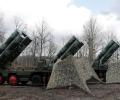
49.4 per cent of India's arms imports between 2016 and 2020 were from Russia.
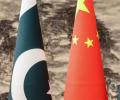
The Chinese military on Monday denied reports that its largest military cargo plane has carried arms supplies to Pakistan and warned legal action against those spreading such rumours.
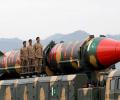
After Donald Trump became president of the United States, he unleashed economic weaponisation, upsetting the old world order, leading to much unrest. If that wasn't all, the threat of an imminent nuclear war was issued by the US, Russia, China, North Korea and Pakistan. In today's fractious times, Dr Paulos Mar Gregorios would have made a dent, notes His Holiness Baselios Marthoma Mathews III.
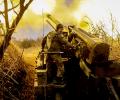
The five largest exporters of major arms in 2020-2024 were the US (43 per cent), France (9.6 per cent), Russia (7.8 per cent), China (5.9 per cent), and Germany (5.6 per cent).

The "bumper" 40 per cent increase followed a number of sweeping reforms intended to transform the "bloated People's Liberation Army, into a more modern, nimble fighting force".
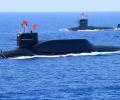
China has delivered a second advanced submarine to Pakistan, part of a larger deal to bolster the South Asian nation's naval capabilities in the Indian Ocean. The move underscores China's growing influence in the region and its strategic partnership with Pakistan.
Russia continued as India's main arms supplier, the Stockholm International Peace Research Institute said.

'The BNP's election manifesto lists grievances against India, mirroring the attitude of past BNP governments.' 'Political parties have been careful not to say bad things about China.'

The nine nuclear-armed states -- the United States, Russia, the United Kingdom, France, China, India, Pakistan, Israel and the Democratic People's Republic of Korea (North Korea) -- together possessed an estimated 13,080 nuclear weapons at the start of 2021.

According to a report released by the Stockholm International Peace Research Institute, India's military expenditure grew around 8.5 per cent in 2016, making it the world's fifth largest spender at $55.9 billion.

The Russians have termed Putin's visit to India, his first to this country since the outbreak of the Russia-Ukraine war, as 'Druzhba Dosti', which means 'friendship' in Russian and Hindi respectively.

India and Pakistan are reportedly expanding their nuclear arsenal, despite a global trend towards disarmament, the Stockholm International Peace Research Institute has said.

Both the Asian giants were among the top three countries spending more on armaments, according to a new report by the Stockholm International Peace Research Institute.
